← Journal · · Digest
ML infra digest: quotas in vLLM, Remote GPU in HAMi, SGLang 1.0
#mlinfra_digest
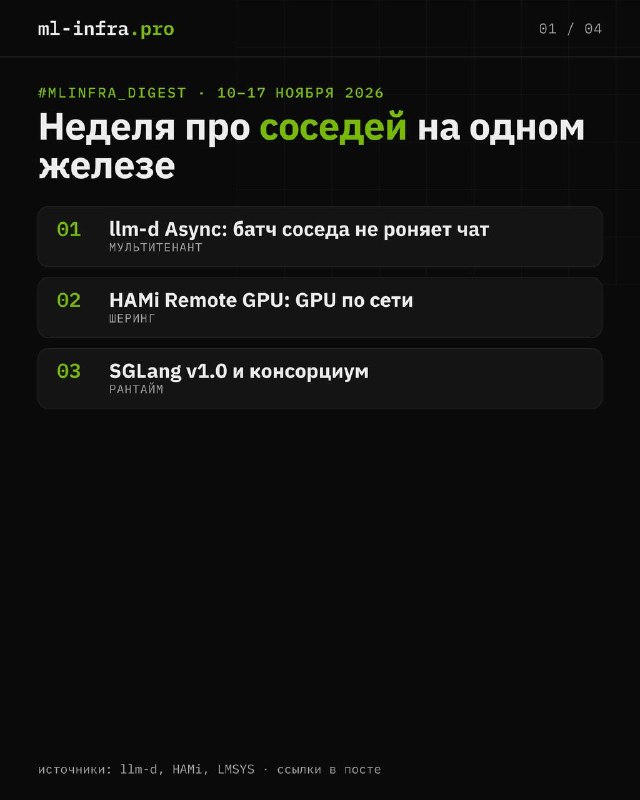
1️⃣ llm-d Async: quotas and queues before vLLM 🔥🔥🔥
Familiar scenario: one team serves chat, another runs batch document processing at night. The GPU pool is shared, but latency requirements are different.
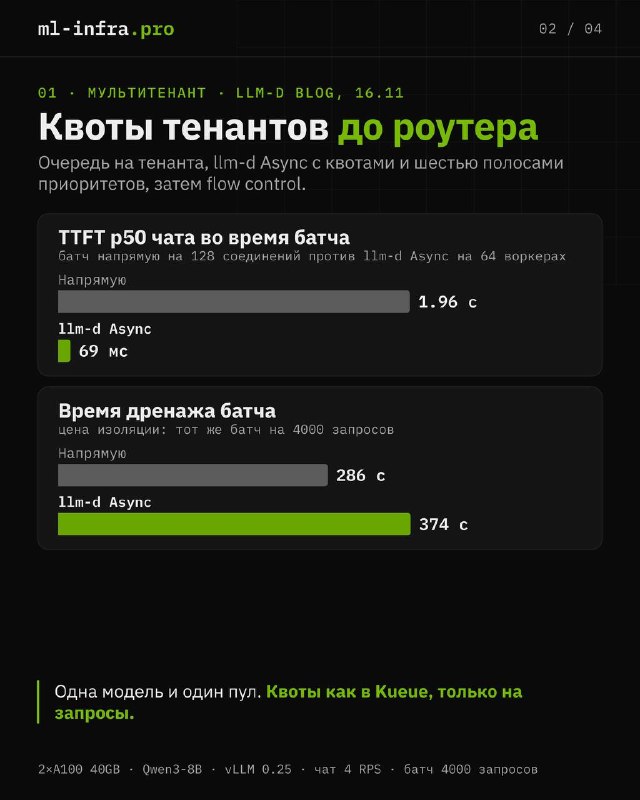
llm-d proposes a queue per tenant, Async workers with quotas and priorities, and feedback from the router. When the queue inside the engine grows, workers slow down request submission. Exceeding quota doesn't necessarily mean rejection: extra requests can go into overflow and wait for free capacity.
In a test on 2×A100 40GB with Qwen3-8B, adding a batch of 4000 requests raised the median TTFT for chat from 44-47 ms to almost two seconds. With Async and 64 workers, they got 69 ms, p99 - 298 ms. Protecting chat isn't free: the batch processed in 374 seconds instead of roughly 285.
It's conceptually similar to Kueue, except quotas apply to requests rather than jobs. For a shared inference pool it looks useful, but a test on one model and one pool isn't yet a guarantee of isolation for arbitrary workloads.
This is super interesting for shared models, especially for those who want to provide their customers with SLA :)
2️⃣ HAMi Remote GPU: pod on CPU node, CUDA over the network
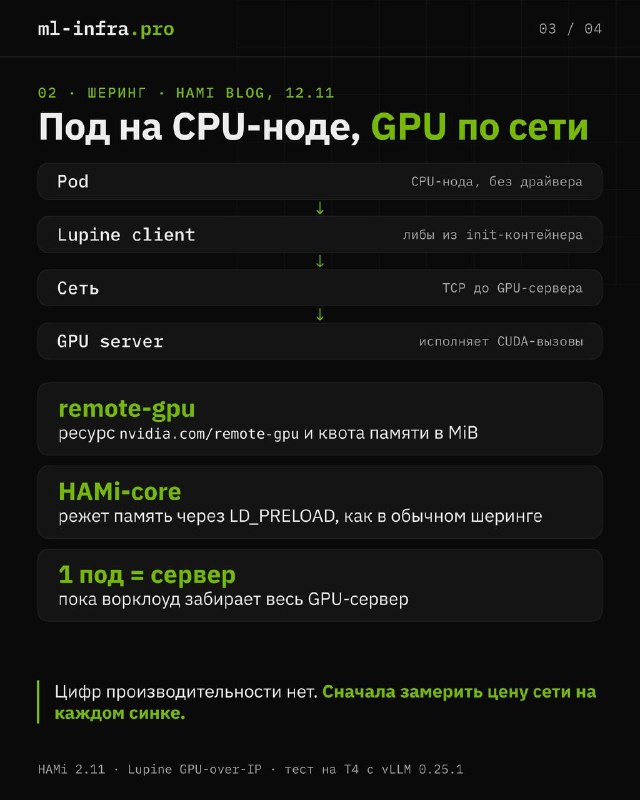
HAMi 2.11 got Remote GPU based on Lupine. An application runs on a CPU node without a GPU driver, and CUDA calls are sent to a remote GPU server.
The pod requests nvidia.com/remote-gpu and memory quota, HAMi uses init containers to inject client libraries and connection settings. In the guide they run vLLM on T4 this way.
For now, one workload occupies the entire GPU server. There are no performance measurements either: the authors verified functionality, not efficiency.
3️⃣ SGLang: v1.0 announcement and consortium around the project
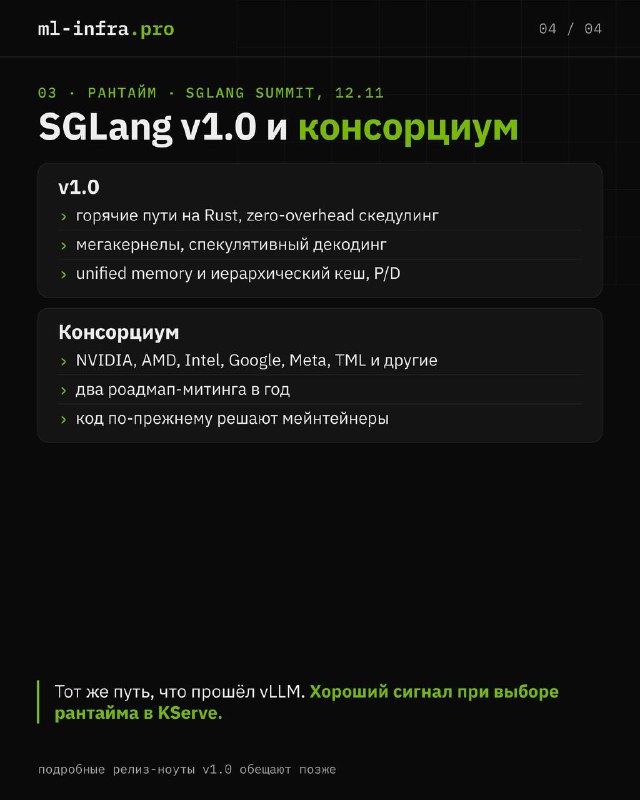
At the first SGLang Summit they presented v1.0. Among the announced changes are hot paths in Rust, scheduling optimizations, megakernels, unified memory for hybrid models, hierarchical cache, and prefill/decode separation. Detailed release notes are promised later, so I'll hold off on conclusions about the readiness of specific features.
Separate news - SGLang Consortium. It includes NVIDIA, AMD, Intel, Google, Meta, Thinking Machines Lab, Cloudflare, Modal, and RadixArk.
Participants will have a technical representative each and two roadmap discussions per year. Code decisions remain with maintainers (though it depends on how you look at it :)