← Journal · · Note
Who exactly is an MLOps engineer?
I recently helped a mentee during a consultation figure out what an MLOps engineer actually is.
Out of about 180 job postings on HH, you'll mostly see titles like:
- MLOps
- DevOps
- ML Engineer
- Data Scientist
- Senior ML Python Developer
- Technical Product Manager )))
and all of them will have something like "MLOps background, MLOps practices." As you can see, the market itself doesn't really understand what it is. A kind of jack-of-all-trades soldier who can do everything.
And my mentee asked me: where should I actually grow, and what does an MLOps engineer even do? :)
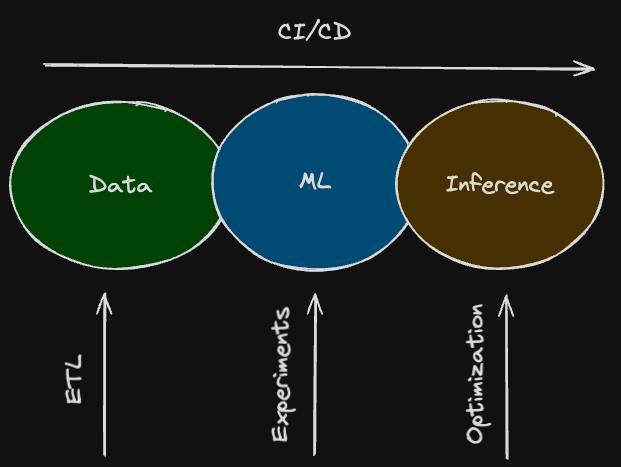
Here's how I answered. 🗣 I drew a small diagram 📈. From my experience, as an MLOps engineer you usually end up working with three entities:
1️⃣ Data: data platforms, your favorite Spark, Airflow, and ETL. Feature stores and Data Lakes
2️⃣ ML: experiments and training automation. MLFlow, ClearML, distributed training, and even GPUs!
3️⃣ Inference: models in production, http/grpc endpoints, high-load traffic, and inference optimization
And here it seems really hard to fit all three entities into one engineer. So I split them into verticals: specialists who mostly live in the infrastructure and processes tied to each circle.
But what if we draw a horizontal line across all three circles? We get a value-delivery pipeline to the end customer, from data preparation to the endpoint. And of course, the job of these engineers is to automate that delivery.
So my answer is: it depends on which specialization you want to grow into :) You can try all three entities, or go deep into one, it depends on the tasks you're working on. I hope the market will figure out what an MLOps engineer is soon enough, and maybe there will even be an interview standard.
For now, at the early stages, study DevOps/Backend/Data Science, since interview standards already exist for those!
Write in the comments what you think about MLOps engineer specializations? LLMOps, InferenceOps, GPU-allocation-engineer, who can come up with more options? :)